Showing posts with label Maya. Show all posts

Friday, December 21, 2012

TULUM AND WHAT WILL REALLY HAPPEN ON 21-12-12


According to Mayan astronomical calculations, something extraordinary will happen this 12/12/21. However, it will have nothing to do with the crazy story about an apocalyptic end of the world, but with alignment of various architectural monuments in the Mayan cities with the position of the sun on that day. One of such cases, less known than Chichen Itza, is Tulum, a city built in the Late Post-classic period (1200-1521 AD) which stands dominant, over a stunning Caribbean seascape of turquoise waters and white sand beaches.


At dawn on the winter solstice, the sun is "framed" on a small window in the building called the Castle, showing the connection of the city not only with its surrounding seascape but with its cosmological environment.


Similar alignments also occur during the equinoxes, when the sunlight passes through an opening and it is projected over a specific building. Such astronomical calculations allowed Mayan rulers to control the population, which must have looked stunned as the sun god was confined and trapped in a building opening following the "orders" of their kings and priests.


For this reason the city was originally known by the Mayans as Zama, meaning "Dawn" and highlights the impact that this phenomenon had on the local collective memory (using astronomical calculations in architecture is not unique to the Mayans, although these had a very advanced calendar system. In this blog we have discussed similar cases such as the Neolithic monuments of Stonehenge in England and Newgrange in Ireland , as well as the sun temples in Ollantaytambo and Machu Picchu in Peru).


However, the current name comes from an urban feature: Tulum means wall or fence and refers to the 380 x 170 meters rectangular wall  which protects the city from three sides (the short ones to the  north and south and the long one to the west).


The east side was protected naturally by the cliff that overlooks the sea, and that gives the city a privileged visibility over the seascape. The gates on the wall are linked in a unique urban pattern based on the existence of paved avenues that connected the entrances with the main temple.


The Castle, front view (from the west)

El Castillo, rear views (from the east)

On the architecture of its buildings, historian Gustavo J. Gutiérrez León writes (quote translated from Spanish) :

"The use of broad bottleneck-shaped vaulted ceiling , typical of the Maya culture, stand along with flat roofs constructed of logs supported on the walls. Internal spaces are rectangular and sometimes extended by the use of central columns which supported a wooden lock -Palace and House of Columns. Occasionally buildings have a columned portico, which in the Castle took shape of snakes, as in the analog building in Chichén Itzá. Internally the structures have two or more rooms, in the deepest one there is a small shrine: Temple of the Frescoes, House of Columns- as in the case of Palenque. Equally common is the use of shrines: small independent structures that do not exceed one meter high.


In general, the buildings are low with facades divided by moldings, thus emphasizing their horizontality. Friezes usually have boards in which a character is represented upside down -Temples of the Descending God and frescoes. The walls of the temples are intentionally tilted outwards, giving a peculiar effect. To counteract the load, the door openings are narrow at the top. The lintels are recessed with respect to the facade beyond the edge of the accesses.


Temple of the Frescoes
But there are also unique architectural features of the place. Stucco masks on the corners of some buildings, such as the Temple of the Frescoes, hence the character is identified as Itzamna, the most important deity in the Mayan Post-classic period. Another feature of the Maya culture in general, linked to architecture, appears in Tulum: mural painting. As elsewhere in the Post-classic period, the characters are gods and not humans anymore -Temple of the Frescoes and the Descending God. "


In 2006 Arquine conducted an academic competition for a museum (never built, by the way) whose winners were the team 5NOVE/Alessandro Consol. The proposal was entirely underground to avoid interfering with the surrounding monuments, but it was connected to the outside by means of light wells in the form of truncated pyramids.


Due to its location, Tulum must have had an important role in regional trade. While the scale of the buildings is not as monumental as in other Mayan cities, nor its building have very special finishings, we were  enormously impressed by its spectacular location in the landscape and their profound astronomical knowledge in the service of architecture .


SEE ALSO
- ANCIENT ARCHITECTURE AND ASTRONOMY


Thursday, December 20, 2012

CHICHEN ITZA


ESPAÑOL

For many years I had wanted to visit Chichen Itza, the spectacular Mayan city located in the forest of the Yucatan peninsula, east of Mexico, long before it was chosen as one of the 7 wonders or that it became fashionable in the tabloids due to an apocalyptic interpretation of the "prophecies" Maya.


Here, we need to use our imagination to picture an impressive citadel, full of colorful monuments whose volumes, painted in ocher, tuquoise, green, orange, white and black, stood stunningly against the blue sky. Like their ancestors of Teotihuacan, the Mayans in Chichen Itza combined architecture with rich and colorful sculptures, evident in the detail of a profuse relief sculpture that represents snakes and other divine creatures.


Mayan cities enjoyed a sophisticated urban and architectural planning , with complex systems of aqueducts, canals and drains.


The city of Chichen Itza was huge and covered an area of ​​24 square kilometers with about 400 stone buildings distributed in 46 groups, that were built over the centuries. While it is not necessary to use the imagination to know the features of its inhabitants, as their descendants walk throughout the complex as craft vendors, it is necessary to imagine their numbers: more than 100,000 inhabitants ( only 10 cities in the world had that population 1000 years ago).


Regarding the urban landscape, I asked our guide how accurate was Mel Gibson's Apocalypto and he replied: "It is out of time, the Mayans were in decline when the Spanish arrived and they did not go to capture prisoners. Aside of that, the representation is quite realistic. "


However, the area that we see today corresponds to a ritual zone and it was encircled by a wall, which means that generally  it could only be accessed by prominent authorities. At night, this area must have become a wonderful spectacle, when the pyramids were illuminated by hundreds of torches, as it is evidenced by the traces of oil found in the pyramids.

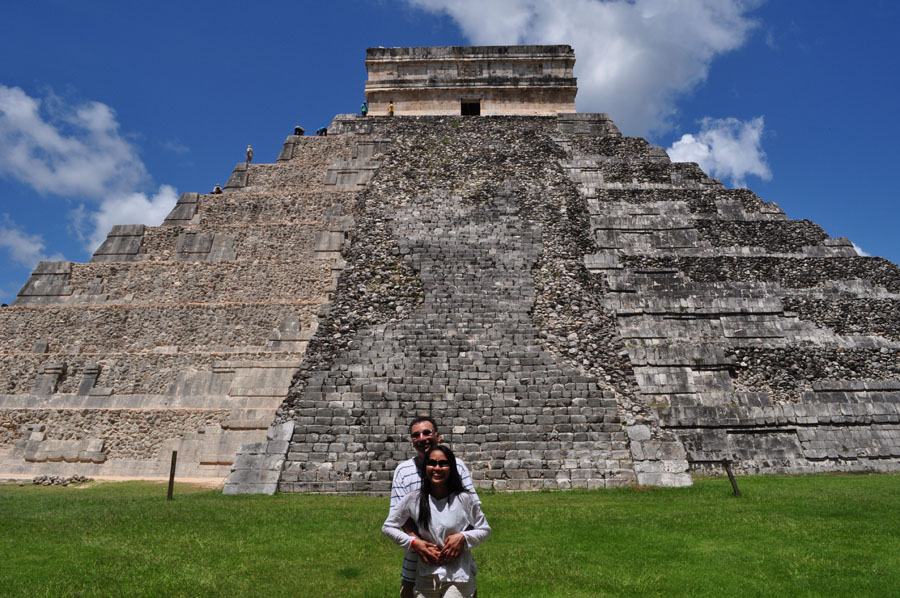
The pyramids were made of limestone joined with a cement made of burnt lime, crushed and mixed with water, and they were often built on top of  previous structures. Excavations confirm that the Kukulcan pyramid stands over three ancient structures, which allowed it to reach a height of 24 meters to the top platform. To these are added the 6 meters of the temple on its peak, reaching a total of 30 m.


Each of the sides of the base measures 55 m, making it smaller than the Pyramid of the Sun at Teotihuacan .


Besides its size and elaborate artistic quality, Chichen Itza is an outstanding example of astronomical knowledge applied to architecture. A detail in the Kukulcan Pyramid, also called "the Castle," are the two serpents that flank the central staircase.


Well, in December 21st, during the winter solstice (yes, the day when "the world ends") the stairs of the pyramid produce a shadow in the shape of a snake and that, starting from the head form the body of the magic reptile, thus uniting heaven and earth. The detailed Mayan calendars also allowed them to understand the cycles of the stars and eclipses, and used that information to govern, control and impress people.


Another impressive aspect in this urban space is the acoustics. The sound was thoroughly studied, and allowed a person to clearly hear the speaker talking at the top of the pyramid. The following video   demonstrates the impressive effect obtained by  a single clap, whose sound was enhanced 10 to 12 times. Can you imagine the cry of a crowd?


The acoustic effect not only occurred in the pyramid, but also in the structure for the ball game.


This was a solemn space, where a game similar to football was played (although it could play with shoulders, elbows and knees) bouncing a rubber ball between two teams of seven players.


The game ended when the ball passed through one of the two rings especially carved in stone located at each side of this space.


The game was a sacred ritual, and the losing team was sacrificed, as evidenced by the reliefs found on one side of the structure


Besides the buildings, the complex contains a large well or cenote, vital for supplying water to the population and where, paradoxically, human sacrifices were offered during  times of drought. Because of them the city is named: Chi Cheen Itz a means "mouth of the well of water witches".

This brings up the huge environmental footprint that the city should have had, not only by the deforestation involving the city area itself, but by the large number of trees and water that was required in the construction process. This forest devastation was one of the causes of the decline of the Mayan civilization. Indeed, the city was abandoned already in the thirteenth century, three centuries before the arrival of the Spanish, due to environmental collapse and the brutality and cruelty of the ruling class, which was then a coalition formed by the Mayans and the Toltecs. The latter subjugated the Maya culture and exercised their power through human sacrifices to worship the sun, which according to them was fed only by the hearts of the sacrificed. For this reason many people fled to the jungle, accelerating the city's  process of collapse.
By the time Europeans arrived in this city, the jungle had claimed it for himself.


SEE ALSO
- ASTRONOMY AND ANCIENT ARCHITECTURE